

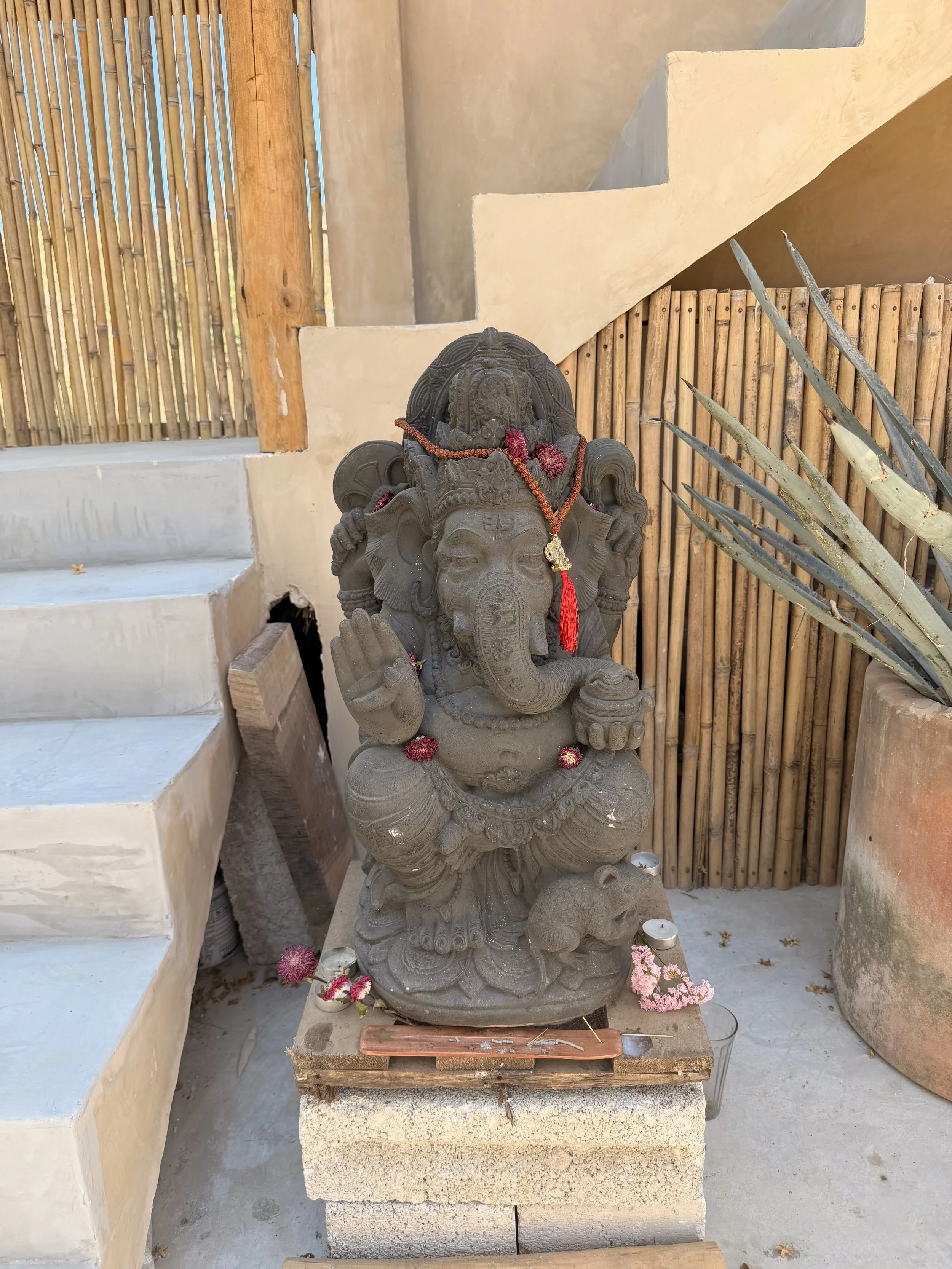
Dharma is often translated as our life's purpose, but I have come to believe it is much more than that. Dharma is the truest expression of who we are when we are living in alignment with our values, our gifts, and the unique way we are meant to serve the world. It is not simply what we do. It is how we move through life with authenticity, integrity, and intention.
One of the greatest misconceptions about dharma is that it is something we have to find. We imagine there is one perfect path, one perfect career, or one perfect calling waiting somewhere in the distance. We spend years searching outside ourselves, believing that one day everything will suddenly make sense.
I no longer believe that.
I believe our dharma already exists within us. It has always been there. What keeps us from living it are the layers we accumulate throughout our lives: fear, shame, perfectionism, people pleasing, disappointment, and the stories we tell ourselves about who we should be instead of who we truly are. The journey toward our dharma is not about becoming someone new. It is about having the courage to uncover who we have been all along.
Over the past few months, I have had the privilege of watching friends, both near and far, walk a little steadier as they journey toward their own dharma. I have watched them make courageous decisions, choose authenticity over approval, leave relationships, careers, and expectations that no longer aligned, establish healthier boundaries, and trust themselves in ways they perhaps never had before.
It has been one of the most beautiful and empowering experiences to witness.
Their paths have not been perfect, nor have mine. There have been missteps, difficult conversations, moments of uncertainty, and seasons of profound growth. Yet watching them has reminded me that dharma is not about getting everything right. It is about having the courage to keep becoming. Every challenge, every choice, and every lesson invites us to peel back another layer so that our truest self can emerge.
Yoga teaches us that one of the pathways toward dharma is svadhyaya, the practice of self study. Self study is far more than reading books or learning philosophy. It is the willingness to honestly observe ourselves. It asks us to examine our thoughts, our reactions, our relationships, and our patterns without immediately judging them. It invites curiosity instead of criticism and awareness instead of avoidance.
The deeper I move into my own practice of self study, the more I realize that living our dharma requires radical honesty. We cannot align with our purpose if we are unwilling to see ourselves clearly. We cannot grow if we spend all of our energy protecting our ego. Dharma asks us to tell ourselves the truth, even when it is uncomfortable.
That truth naturally leads to accountability.
Accountability is one of the greatest expressions of living in alignment with our dharma. It is the willingness to acknowledge when we have caused harm, when we have acted from fear instead of love, or when our actions no longer reflect the person we are becoming. Accountability is not about proving that we are bad people. It is about remaining committed to becoming better ones.
Without accountability, we remain attached to old versions of ourselves. We repeat the same patterns, protect the same stories, and convince ourselves that growth belongs to everyone else. Every time we choose accountability over defensiveness, we remove another layer separating us from our dharma. We become more aligned with the person our soul has always known we could be.
Of course, accountability often awakens something much more difficult, such as shame. Shame whispers that our mistakes define us. It convinces us that if others knew the whole story, they would leave. It encourages us to hide, defend, justify, or pretend. Yet none of those responses create freedom. They simply keep us disconnected from ourselves and, ultimately, disconnected from our dharma.
The only way shame loses its power is by bringing it into the light.
That does not mean sharing our deepest wounds with everyone we meet. It means allowing ourselves to be seen by the people we trust. It means speaking honestly, asking for forgiveness when it is needed, and remembering that making a mistake is not the same as being a mistake.
Our dharma cannot be lived from behind a mask. We cannot fully express our gifts while we are busy protecting an image of perfection.
This is where grace becomes essential.
I have come to believe that grace and accountability are not opposites. They are partners. Accountability without grace becomes self punishment. Grace without accountability becomes avoidance. We need both if we are going to continue walking our path.
I am human. I make mistakes.
Sometimes I say the wrong thing. Sometimes I misunderstand. Sometimes I hurt people without intending to. Sometimes I need to apologize. Sometimes I need forgiveness. Most importantly, I have learned that I also need to offer myself grace. If I believe one mistake disqualifies me from living my dharma, then I will never have the courage to keep walking toward it.
None of us are meant to walk this path alone, we all need champions.
Not people who simply tell us what we want to hear, but people who love us enough to remind us of who we are when we lose sight of ourselves. The greatest champions celebrate our strengths while gently challenging us when we have drifted away from our values. They remind us of our dharma when fear, shame, or disappointment begin speaking louder than our inner wisdom.
Their role is not to walk our path for us, it is to lovingly point us back toward it.
The more I reflected on these qualities, the more I realized that Ayurveda has always described this journey in its own beautiful way.
In Ayurveda, we speak of Agni, our digestive fire. While we often think of Agni as the fire that digests our food, it also represents our ability to digest life itself. Every conversation, every disappointment, every success, every heartbreak, every apology, every loss, and every lesson arrives asking to be processed, transformed, and metabolized.
When our Agni is healthy, we are able to transform our experiences into wisdom. We learn from them, integrate them, and allow them to shape us without allowing them to define us. When our Agni is weak, however, we begin carrying experiences we have never fully processed. Old shame, resentment, grief, regret, and identities remain lodged within us, quietly influencing every decision we make.
In Ayurveda, what cannot be digested becomes ama, a toxic residue that accumulates within the body. I often wonder if the same is true emotionally. When we refuse accountability, cling to shame, or remain attached to our past, those experiences become emotional ama. They cloud our ability to see ourselves clearly and prevent us from stepping fully into our dharma.
Perhaps tending our Agni is really about tending our capacity to transform.
Accountability fuels that fire.
Grace keeps it steady.
Our champions protect it.
Honesty allows it to burn brightly.
Every experience we are willing to fully process becomes nourishment instead of burden.
We cannot journey toward our dharma while carrying everything we have refused to metabolize. Our soul's purpose is not found by outrunning our past. It is uncovered when we allow our experiences to transform us instead of imprison us.
Walking My Dharma
As I reflect on this season of my life, I realize that I feel steadier in my dharma than I ever have before.
That doesn't mean I have all the answers. It doesn't mean life has become easier. It simply means I have stopped searching for my purpose somewhere outside of myself. Instead, I have begun trusting what has quietly been calling me all along.
For years, I thought my purpose was tied to a title or a role. Life has taught me otherwise. It has stripped away identities I thought defined me and revealed something much deeper.
My dharma has never been about a job, it has always been about helping people heal.
With women, that healing often begins in my Ayurvedic clinic. Through bodywork, herbal wisdom, yoga, breathwork, and compassionate conversation, I have the privilege of watching women reconnect with the wisdom already living within them. Together, we tend their Agni so they can begin processing not only the food they eat, but also the grief, shame, fear, expectations, and stories they have carried for years. I watch them soften, release what no longer serves them, and remember that healing is not about becoming someone different. It is about returning to themselves.
With children, my dharma takes on a different form, yet its heart remains exactly the same. As a forensic interviewer, I have the privilege of sitting beside children during some of the most difficult moments of their lives. Through trauma informed conversations, my role is not simply to gather information. It is to create a space where children feel safe enough to tell their story, knowing they will be met with compassion, curiosity, and belief. It is an opportunity to help loosen the shame, guilt, fear, and silence that trauma so often leaves behind, reminding them that what happened to them is never the measure of who they are.
At first glance, these two paths appear worlds apart. One is rooted in ancient healing traditions. The other is grounded in trauma informed care. Yet the longer I walk them, the more I realize they are expressions of the same dharma.
Both ask me to witness without judgment. Both ask me to hold space with compassion. Both ask me to help others process what has become too heavy to carry alone. Both ask me to trust that healing begins when people feel safe enough to tell the truth. Perhaps that is why this reflection feels so personal.
I am not writing from a place of having arrived. I am writing as someone who is still practicing self study, still learning accountability, still bringing shame into the light, still tending my own Agni, and still relying on the champions in my life who lovingly remind me who I am when I lose my way.
Uncovering our dharma is not a destination, it is a lifelong practice.
Every act of honesty removes another layer. Every moment of accountability brings us back into alignment. Every time we bring shame into the light, we make room for healing.
Every champion who lovingly reminds us who we are helps us return to our path. Every experience we metabolize through the fire of Agni clears another obstacle from the journey.
Perhaps the journey toward our dharma has never been about finding our purpose at all. Perhaps it is about becoming courageous enough to live as the person we were always meant to be.
